
Wholesale Marketplaces for International Buyers: The Corner Only Grovara Fills
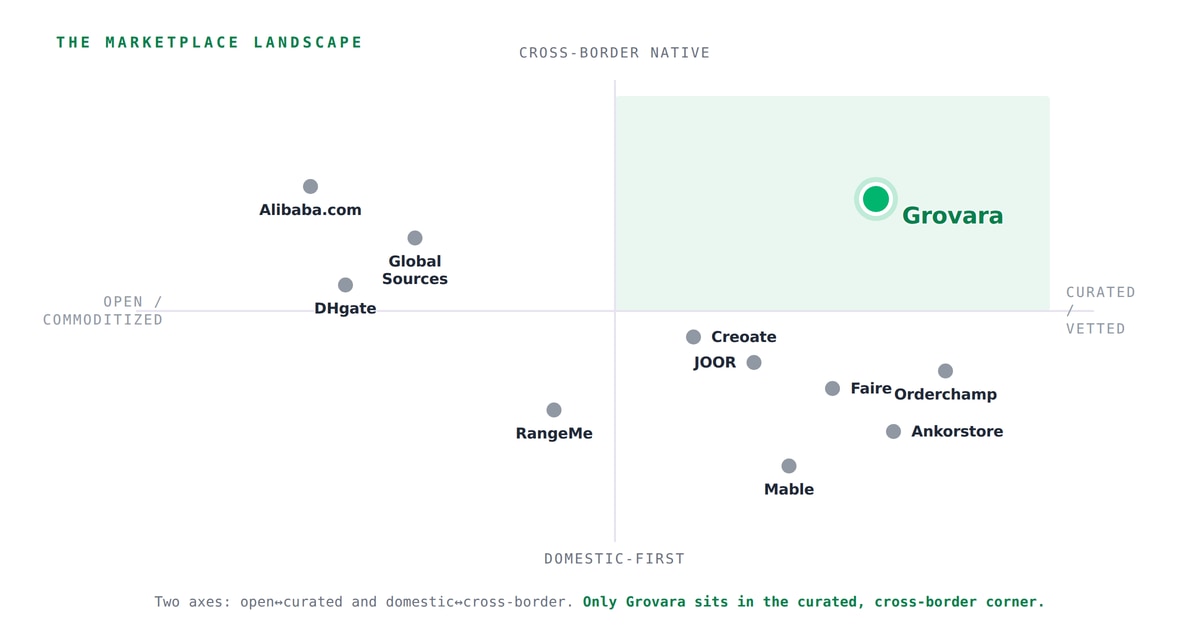
For an international buyer, two things decide a wholesale marketplace before its catalog: whether the products are vetted and authorized for your market, and whether the platform runs the cross-border trade or leaves the customs and compliance work on your desk.
The open giants like Alibaba.com and DHgate list nearly everything and vet almost nothing, so screening the supplier and clearing customs falls to you. The curated platforms like Faire and Ankorstore vet the brands but are built for buyers inside Europe and North America. Grovara vets both sides and runs the export trade for buyers in 60+ countries.
On an open platform the danger is inside the catalog. Working out whether stock is authorized for your territory, or diverted from elsewhere, is your problem, and a wrong call means gray-market goods or a counterfeit claim. Curated platforms take that risk off the table, but most of them will not ship to a buyer outside their home region.
Every platform below was checked live on 28 July 2026 and is trading. Three names that still turn up in older comparisons have shut down, and they are covered near the end rather than dropped. Grovara is our platform, and its entry names what it does not do.
Quick comparison
| Marketplace | What it sells | Buyer reach | Best for |
|---|---|---|---|
| Alibaba.com | Factory-direct, nearly every manufactured category | Almost anywhere | Widest supplier choice and lowest unit price |
| Global Sources | Electronics, mobile, lifestyle electronics | Almost anywhere | Meeting Asian factories face to face |
| DHgate | General merchandise, low minimums | Almost anywhere | Testing a line at small volume |
| Grovara | Branded consumer goods, vetted both sides | Open signup; trades across 60+ countries | Verified partners with export paperwork automated |
| Faire | Home, gift, beauty, apparel, stationery | 34 countries only | Independent retailers inside those 34 markets |
| Ankorstore | Independent European brands, multi-category | Europe only (~28 countries) | European shops buying European brands |
| Creoate | Multi-category independent brands | UK, US, parts of the EU | Transatlantic buying between the UK and US |
| Orderchamp | Home and living, fashion, beauty | EU and UK only | EU retailers wanting net terms |
| JOOR | Fashion, footwear, accessories | Open signup | Apparel buyers working from digital linesheets |
| RangeMe | Discovery only, no checkout | 7 regions | Finding new products, not ordering them |
| Mable | Food and beverage | United States (no evidence of non-US signup) | US independent grocery |
Why only one marketplace fills the curated, cross-border corner
Two questions sort these platforms more cleanly than any feature list. One axis is open versus curated: can anyone list, or is every party vetted before they trade? The other axis is domestic versus cross-border: does the platform run the trade across the border for you, with the compliance documents and the logistics into another country, or does it connect parties inside one region and leave the border to you? The map at the top of this page plots all eleven on those two axes.
Read that way, the field falls into corners. Alibaba.com, Global Sources and DHgate sit in the open cross-border corner: huge reach and no curation, so the vetting is yours to do. Faire, Ankorstore, Orderchamp and Mable sit opposite. They are curated but region-locked to mostly European or North American buyers, so an importer outside those markets meets them as domestic-first platforms. Creoate and JOOR are curated and cross a border only in a limited way, through a few defined lanes or a single vertical. The curated cross-border corner, vetted on both sides and built to move the order across the border, is close to empty.
Grovara sits in that corner. The position has a cost. Vetting both sides and automating the export paperwork on every order is why its catalog is orders of magnitude smaller than the open giants', and Grovara does not yet fund buyer credit the way Faire does. No single corner wins. Each corner is a different trade-off, so you pick the one that matches how you buy.
Read the circles as: ● strong, ◐ partial, ○ limited or none.
| Marketplace | Buyer reach | Curation & vetting | Cross-border trade run for you | Catalog breadth | Lowest unit price | Financing |
|---|---|---|---|---|---|---|
| Alibaba.com | strong | limited or none | limited or none | strong | strong | limited or none |
| DHgate | strong | limited or none | partial | partial | strong | limited or none |
| Faire | limited or none | strong | limited or none | strong | partial | strong |
| Ankorstore | limited or none | strong | limited or none | partial | partial | partial |
| RangeMe | partial | partial | limited or none | strong | limited or none | limited or none |
| Mable | limited or none | strong | limited or none | partial | partial | partial |
| Grovara | strong | strong | strong | partial | strong | limited or none, in development |
Financing, Coming Soon to Grovara
Grovara is building embedded financing for both sides of the trade, brands and buyers. Soon you will order and pay on terms directly through the platform, with no separate lender to line up.
1. Alibaba.com: the widest factory-direct catalog
Alibaba.com is the export-facing B2B marketplace of the Alibaba group, and it differs from its siblings. AliExpress sells single units at retail. 1688.com handles domestic Chinese trade in Mandarin with no official cross-border support. Alibaba.com is the one built for importers. Suppliers are mostly Chinese manufacturers, and buyers register from almost anywhere.
Its advantage is density. Through the request-for-quotation tool you put one specification in front of a dozen competing factories and compare what comes back, which is hard to replicate anywhere else. Trade Assurance holds payment until the order arrives as described. Minimums are wholesale quantities at factory pricing.
There are costs too, starting with what a supplier badge does and does not prove. The badges are not equal. Gold Supplier is a paid membership with a document check. Verified Supplier adds a third-party on-site audit, but that audit is a once-a-year snapshot. It covers registration and capability, not your product's quality, so sampling and due diligence stay with you. Unless a supplier quotes delivered-duty-paid, you arrange the freight and the customs clearance yourself, and product compliance stays with you.
Best for: importers who want factory-direct pricing across almost any manufactured category and have the expertise to vet suppliers themselves.
2. Global Sources: the closest Alibaba alternative for Asian manufacturing
Global Sources pairs an online supplier directory with physical trade shows in Hong Kong and regional editions in Indonesia, Saudi Arabia and Vietnam. Consumer electronics, mobile accessories and lifestyle electronics are where its supplier bench runs deepest. Its April 2026 Hong Kong show reported more than 130,000 visitor entries from over 180 countries and regions, with new buyers making up more than half of attendance.
What a pure directory cannot offer is the handshake: a business-matching service pairs buyers with relevant suppliers, and the shows let you inspect samples and read a factory's people before committing a purchase order.
The limitations follow from the same design. Category range is narrower than Alibaba's, and a meaningful share of the platform's value assumes you can travel, which prices out smaller buyers. Its online payment protection is also less prominent than Alibaba's Trade Assurance.
Best for: electronics and lifestyle-electronics buyers who want to meet factories in person before committing to volume.
3. Why DHgate still works for small test orders
DHgate is a Beijing-based cross-border marketplace founded in 2004 that sits between wholesale and retail. It was built for international buyers from the start and does not gate registration by country, which alone puts it ahead of most curated platforms for anyone outside Western Europe and North America.
Minimums are its selling point. You can test a line at a few dozen units rather than committing to a container, and escrow-style buyer protection holds funds until you confirm the goods arrived.
Two cautions. Quality control and intellectual-property risk run higher here than on more heavily vetted platforms, and checking a seller falls almost entirely on you. The landed-cost math also changed for anything shipping into the United States: Executive Order 14324 suspended duty-free de minimis treatment for shipments valued at $800 or less from all countries on 29 August 2025, and US Customs and Border Protection made that suspension indefinite in June 2026. Small parcels that once cleared duty-free now carry full duty, eroding the advantage DHgate's small-order model was built on for US buyers.
Best for: smaller buyers and resellers testing products at low volume who can absorb variable quality and have priced in duty.
4. Grovara vets both sides and automates the export paperwork
Grovara is a global wholesale marketplace where brands and buyers trade with vetted partners. It connects 10K+ brands and buyers across 60+ countries on one platform, with Scout AI™ supporting discovery and negotiation.
Both sides are vetted before they can transact. That addresses the gray-market problem an importer meets on open platforms, where working out whether stock is authorized for your territory or diverted from elsewhere is hard. Exclusive distribution rights are negotiable on the platform. Payments and logistics are automated per order, and the platform generates the compliance documents alongside the order. The paperwork that stalls first-time importers, like the certificate of free sale and the origin documents, arrives with the order instead of being chased over email.
What it is not: our catalog is smaller than Alibaba's or DHgate's by orders of magnitude, and vetting both sides of every transaction is precisely why. If you want the widest choice of factories for a commodity item, a factory-direct megamarketplace will beat us on selection. Grovara also connects you to brands rather than contract manufacturers, so it is the wrong tool for developing a private-label product from scratch.
Best for: distributors and retailers importing branded consumer goods who want the partner and the paperwork verified before anything ships. You can browse the wholesale product catalog without an account.
5. Faire is curated, but only if you are in one of 34 countries
Faire is the best-known curated wholesale marketplace, connecting independent retailers with brands across home, gift, beauty, apparel and stationery. Shopify named it the recommended wholesale marketplace for its merchants in 2023, a fair signal of catalog quality.
For most international buyers, the catch is coverage. Faire's own help center lists the countries where retailers can register and receive orders: 34 in total, covering the United States and Canada, most of the European Economic Area, the UK, Switzerland, Australia and New Zealand. The same page states that "if you're located outside of these approved locations, we're currently unable to fulfill orders," and that Faire does not allow forwarding shipments through third-party fulfillment centers or mail forwarders, so the obvious workaround is explicitly closed. Several listed countries also carve out their own territories: Spain excludes the Canary Islands, Ceuta and Melilla, and the United States excludes Puerto Rico.
Inside that list the buyer proposition is strong. Minimums are low or zero across thousands of brands. Qualifying orders get interest-free net-60 terms, and a first order with any brand has free returns. You are buying finished goods rather than sourcing from factories, so unit prices sit above factory-direct. That is the trade for curation and terms.
Best for: independent retailers inside those 34 markets. Anyone outside them needs a different platform, and catalog quality does not change that. Buyers searching for sites like Faire from an unsupported country should start with the three curated platforms below and read their geography before browsing the catalog.
6. Ankorstore: the European alternative to Faire
Ankorstore is a general-merchandise wholesale marketplace connecting independent brands with independent retailers across home, beauty, food, fashion, jewelry, children's and stationery categories. Its January 2026 product update describes shipping organized into an eight-country core zone (Austria, Belgium, France, Germany, Italy, the Netherlands, Spain and the UK) plus a second zone covering roughly twenty more European countries, alongside zero commission on reorders.
The catalog of independent European brands is distinctive, payment terms have historically been generous to retailers, and the platform is visibly still shipping features, which matters more than it sounds in a category where several competitors stopped.
Two marks against it. The geography is Europe and nothing else, so a distributor outside the continent has no route in. And the company cut 190 roles, around 14% of staff, in March 2023; recent retailer reviews mention slower support and confusion over when payment terms apply.
Best for: retailers with a European entity sourcing independent brands across home, beauty and lifestyle.
7. Creoate reaches the UK, the US and parts of the EU
London-based Creoate is multi-category (fashion, beauty, home, stationery, kids, pets, some food and drink), and it is the only curated platform here that opens buying lanes on both sides of the Atlantic. Its help center sets out which lanes are open: US buyers can shop UK and US sellers plus a subset of EU sellers; UK buyers reach UK, US and all EU tiers. EU-based buyers in Belgium, France, Germany, Ireland and Luxembourg (EU1) and Austria, Denmark, Finland, Italy and Sweden (EU2) can shop UK sellers only; buyers in Spain, Portugal and the Netherlands (EU3) can also shop US sellers. Creoate describes these EU lanes as beta and open to selected retailers.
Three regions instead of one is an advantage if your buying spans the Atlantic, and filtering brands by shipping country means you see who will actually deliver to you rather than discovering it at checkout. Payment terms are available to eligible brick-and-mortar retailers.
Beyond the UK, EU and US there is no coverage, and cross-border customs paperwork stays the brand's and buyer's responsibility. One number does not add up if you are sizing a catalog: Creoate's homepage cites both "1,000+" and "over 6,500" independent brands in different places.
Best for: UK and US independent retailers who want a multi-category catalog with working transatlantic reach.
8. Orderchamp: EU and UK, with net terms
Amsterdam-based Orderchamp covers home and living, fashion and beauty for European independent retailers, with payment terms of up to 60 days after delivery, low minimums and an optional dropshipping model. It has shipped a B2B order portal, so development is active.
The boundary is set by how the platform is structured rather than by a policy page. Orderchamp acts as merchant of record through Dutch and German entities with additional registrations in Belgium, Austria, France and Denmark, and its help center requires retailers to hold a valid VAT number in the EU country of delivery, meaning a value-added tax registration, or declare small-business status. Buyers outside the EU and UK have no signup path.
Best for: EU and UK retailers who want long payment terms on European independent brands. Not usable from anywhere else.
9. JOOR: fashion wholesale, brand by brand
JOOR is a wholesale management platform for the fashion industry rather than an open marketplace. Brands pay to onboard and publish digital linesheets; retailers open a free buyer account and write orders against them. The company reports more than 14,000 brands and 700,000 retail buyers.
Buyer signup is self-service with no stated geographic restriction, unusually accessible for a curated platform, and it carries a working transaction layer (assortment building, order status, payment) rather than discovery alone. The catch is that a free account is a door rather than a key: access to any particular brand's linesheet still depends on that brand accepting the retail relationship. It is also fashion, footwear and accessories only, with no customs or freight automation.
Best for: apparel and footwear buyers who want digital linesheets and order management across a large fashion catalog.
10. RangeMe is discovery, not ordering
RangeMe is a product-discovery platform, not a marketplace, though it is routinely listed as one. There is no checkout. Suppliers publish profiles, retail buyers search them, request samples and open conversations, and everything after that happens off the platform. Buyer regions are a fixed set: Australia, Canada, Europe, Mexico, New Zealand, the UK and the US. Suppliers carry the cost, with paid tiers starting at $99 a year.
For a category buyer building a shortlist it is free and the brand base is large. For an importer who needs the order placed and then shipped with its documents, it solves the first step only.
Best for: retail category buyers hunting new products to feed into a buying process they already run.
11. Mable: US food and beverage only
Mable connects independent grocers and specialty retailers in the United States with food and beverage brands that drop-ship orders directly. Signup is free, buyers pass a business-verification check, and minimums are low compared with traditional distribution.
The deciding fact is simple: we found no evidence of buyer registration outside the United States. If you are importing, Mable is a useful window into what independent American grocery is stocking and a reasonable place to identify brands you might then source through an export channel. It is not itself that channel: our guide to American wholesale suppliers covers the routes that are.
Best for: US-based independent grocery and specialty retailers.
Three marketplaces that no longer exist
Comparison articles in this category age badly, and several widely shared ones still recommend platforms that closed years ago. All three below were checked on 28 July 2026.
- Tundra announced in July 2023 that it was shutting down its marketplace, having sued Faire on antitrust grounds that May. A reduced successor called Wholesale Co-Op shut down on 31 January 2024, and tundra.com no longer serves a working site.
- Handshake, the wholesale marketplace Shopify acquired in 2019, was retired around October 2023, weeks after Shopify invested in Faire and named it the recommended wholesale marketplace for Shopify merchants. Today handshake.com redirects to a Shopify blog article. It is unrelated to joinhandshake.com, the student careers network.
- Abound closed its wholesale program in June 2023 and pivoted to dropshipping under the name Droply; Carro acquired both in January 2024, and helloabound.com now redirects to Carro.
Before you build a sourcing plan around any platform, load its homepage and its help center. A dead marketplace and a bot-protected one look similar from a search results page and are not remotely the same thing.
How to choose a B2B wholesale platform
Working through the list above in a sensible order saves a great deal of time:
- Decide whether you are buying brands or sourcing from factories. Factory-direct platforms give you price and control over specification; brand marketplaces give you products that already have packaging and positioning, and sometimes existing demand.
- Work out who carries compliance. On most platforms it is you. Certificates of free sale, origin documentation, import registration and country-specific labeling are the steps that actually delay shipments, so a marketplace that generates them changes your timeline more than a discount does.
- Price the landed cost. That means unit price, freight, duty, clearance and any local registration fee. Duty stopped being a rounding error on small parcels into the United States when de minimis treatment ended.
- Read minimums and payment terms together. A low minimum with prepayment can tie up more working capital than a higher minimum on net-60. Model the cash position, not the order value.
- Check it serves your country. On curated platforms the supported-country list rules out most buyers outside Europe and North America, so check it before you invest time in the catalog.
- Confirm the platform is still trading. Check the homepage loads, look for a dated product update from the past few months, and be skeptical of any comparison article that does not say when it last checked.
If you are approaching this from the other side, as a brand looking for the distributors and importers who buy on these platforms, the mechanics of finding and vetting them are covered in our guide for companies looking for distributors.
Source vetted brands across 60+ countries
Most platforms above solve one part of importing well and leave the rest to you. Some hand you a large catalog and no documents. Others give you factory pricing and expect you to handle vetting and clearance yourself. Grovara connects brands and buyers, 10K+ of them across 60+ countries, on one platform where partners are vetted before they transact. Compliance documents and logistics are automated on every order, and payments run on the platform.
If you are a distributor or retailer sourcing branded consumer goods and you would rather verify the partner up front than reconstruct the paperwork trail afterwards, browse the wholesale catalog on Grovara and create an account to start trading.
Frequently asked questions
What is the best wholesale marketplace for international buyers?
It depends first on where you are based, because most curated marketplaces restrict who can register. Alibaba.com, Global Sources, DHgate and Grovara accept buyers from most of the world. Faire, Ankorstore, Orderchamp and Creoate limit signup to fixed lists of mostly European and North American countries. Once registration is settled, choose on what you are buying. Some platforms are factory-direct. Others carry branded consumer goods, or one vertical such as fashion.
What is the difference between an open and a curated wholesale marketplace?
On an open marketplace such as Alibaba.com or DHgate almost anyone can list, so reach and price are strong but vetting the supplier is your responsibility. On a curated marketplace every party is checked before they can trade, which lowers gray-market and counterfeit risk at the cost of a smaller catalog. Most curated platforms are also region-locked; the ones that are both curated and built to run cross-border trade, with compliance and logistics included, are rare. Match the model to whether you value widest choice and lowest price or verified partners with the paperwork handled.
What are the best alternatives to Alibaba?
Global Sources is the closest like-for-like alternative for Asian manufacturing, with a stronger electronics bench and physical trade shows for factory vetting. DHgate suits smaller cross-border orders with lower minimums. Grovara is the alternative for buyers who want branded consumer goods from vetted partners, with export documents and logistics automated and payments handled on the platform, rather than raw factory sourcing they must vet and clear themselves.
What are the best sites like Faire for buyers outside its approved countries?
Faire only covers retailers in 34 countries and does not permit mail forwarders, so buyers elsewhere need a platform that accepts registration worldwide. Grovara trades across 60+ countries with vetted partners on both sides. Alibaba.com and DHgate accept buyers almost anywhere but sell factory-direct rather than curated brands. Within Europe, Ankorstore, Orderchamp and Creoate are the closest equivalents to Faire, though each carries its own geographic limits.
Which wholesale marketplaces accept buyers worldwide?
Alibaba.com, Global Sources and DHgate do not gate buyer registration by country, and Grovara operates across 60+ countries. JOOR offers open self-service buyer signup but only covers fashion. Faire, Ankorstore, Orderchamp, Creoate, RangeMe and Mable all restrict buyer registration to defined regions, and Mable appears to cover the United States only.
Is Tundra still operating?
No. Tundra shut down its wholesale marketplace in July 2023 after filing an antitrust lawsuit against Faire, and its successor Wholesale Co-Op closed on 31 January 2024. Two other frequently recommended platforms are also gone: Shopify retired Handshake around October 2023, and Abound closed its wholesale program in June 2023 before being acquired by Carro in January 2024.
What should an international buyer check before a first order on a wholesale marketplace?
Confirm the platform accepts buyers in your country. Then establish who is responsible for export and import documentation and who arranges freight and customs clearance. Check what recourse exists if the goods do not match the listing. Model the landed cost rather than the unit price: duty on low-value parcels into the United States is no longer waived, since de minimis treatment was suspended for all countries in August 2025 and made indefinite in June 2026.
Sources
- Alibaba.com (opens in new tab)
- Global Sources (opens in new tab)
- DHgate (opens in new tab)
- Faire Help Center — Availability for retailers (supported countries) (opens in new tab)
- Ankorstore — Product news, January 2026 (opens in new tab)
- Creoate Help Center — Where is Creoate available (opens in new tab)
- Orderchamp Help Center — How does Orderchamp handle VAT (opens in new tab)
- JOOR (opens in new tab)
- RangeMe (opens in new tab)
- Mable (opens in new tab)
- Federal Register — Notice of Implementation of Executive Order 14324, Suspending Duty-Free De Minimis Treatment for All Countries (opens in new tab)
- Business of Home — Inside the lawsuit between Faire and Tundra (opens in new tab)
- TechCrunch — Shopify quietly acquired Handshake (opens in new tab)
- Carro (opens in new tab)