
Scout Copilot Works Inside Every Grovara Order Chat
Grovara’s operations team can now tag Scout Copilot inside an order thread to pull live data, change the order, or hand off a follow-up. For the brands and buyers on the other side of those threads, it means faster answers and follow-ups that land on time.
Scout Copilot is live in the order and account chats on the Grovara platform. An ops manager types @Scout Copilot in a thread and asks a question in plain language. Scout reads the live order, checks the data, and posts the answer in the same thread.
It can also make the change: order state, terms, line items, discounts, shipping addresses. And it takes standing assignments, so “remind me Thursday if the brand hasn’t confirmed” becomes something that happens on Thursday.
It reads along the whole time, too. Every order on Grovara carries a running assessment that Scout refreshes on its own, so it walks into the conversation already knowing where the deal stands.
Why we built it
Cross-border wholesale runs on threads. Grovara carries more than 20,000 chats and over 80,000 messages, and close to nine in ten of them come from our own team. That is on purpose: every account here has a human on it who knows the deal.
A lot of that volume is data moving between people. A buyer asks whether a revised quantity changes the case price, and an ops manager brings back the number from the order and the product record. Scout puts that answer in the thread in seconds instead, which hands the team its hours back for the parts of a deal that need a person: the negotiation, the relationship, the judgment call.
Everything Scout answers from is data Grovara already holds. What is new is that it now speaks up in the conversation.
Scout answers 90% of the questions our team asks it correctly on the first pass. It answers in the open, under its own name, in the thread the account manager is already reading, so anything it gets wrong is visible to the person who owns the account in the moment rather than a week later.
“Grovara is the operating system for a brand’s export business, and Scout is a teammate working inside it,” said Peter Groverman, CEO of Grovara. “Scout sits in the thread with my team, looking at the same order they’re looking at. The reason I care is leverage. This is how a team our size covers a book of business that would otherwise need twice the headcount.”
What it looks like
An ops manager is working an open order with a Gulf distributor. The buyer has asked whether the revised quantity changes the case pricing.
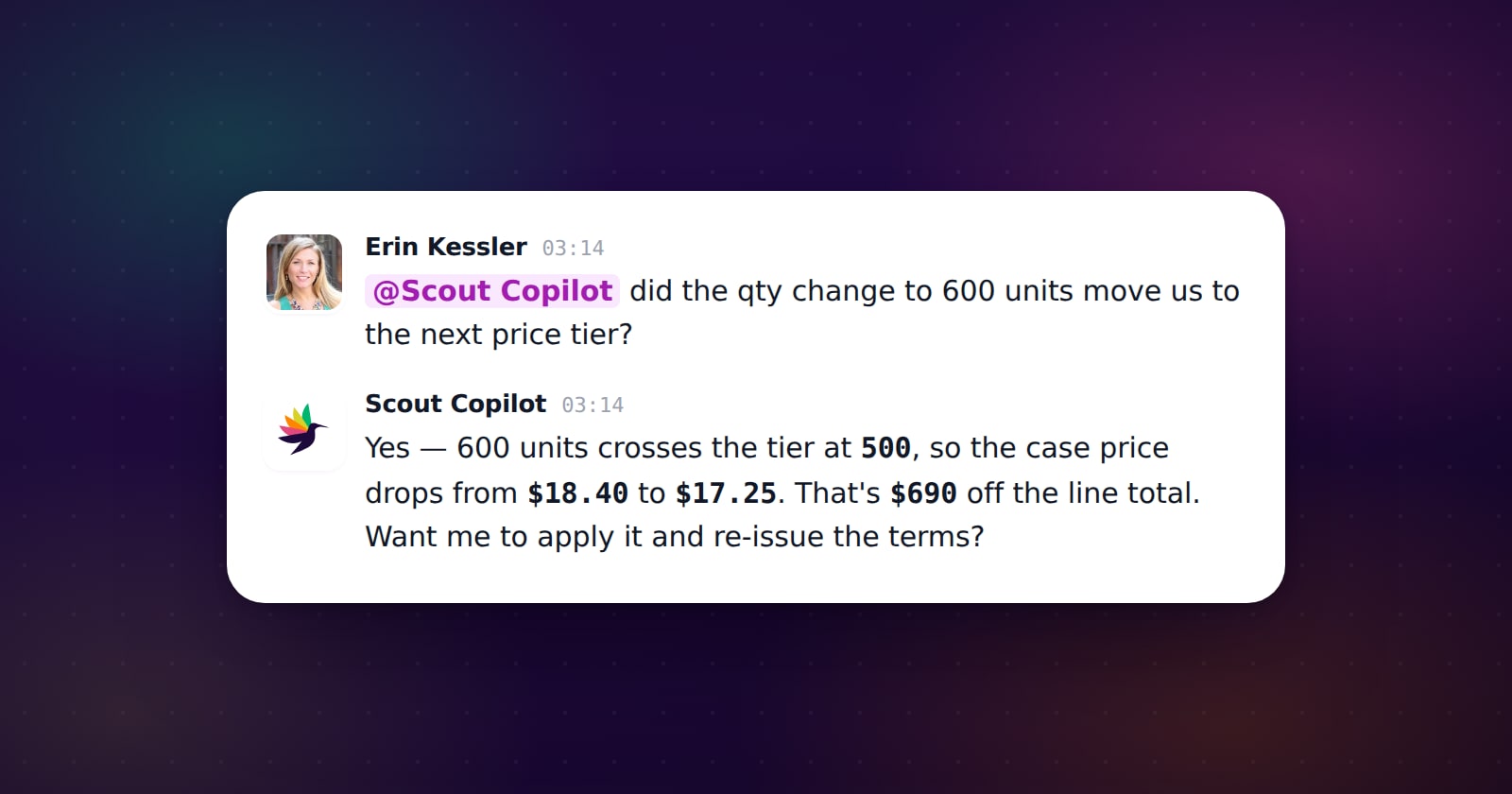
The manager types: @Scout Copilot did the qty change move us to the next price tier?
Scout drops a bot emoji on the message within a second, the way a colleague reacts to say they have it. Then it checks the order and the product’s cost tiers and posts:
Yes — the bump from 480 to 600 units crosses the tier at 500, so the case price drops from $18.40 to $17.25. That’s $690 off the line total. Want me to apply it and re-issue the terms?
The manager replies @Scout Copilot yes, apply it, and Scout updates the order. Lookup, decision, and write, all in one thread.
Scout works in the open. It has its own name and its own face in the thread, and its answers are regular messages, so the whole team on that deal reads them at the same time. There is one Scout in the conversation, not a private assistant per person. Whoever is closest to the problem tags it next, and it answers with the thread’s full history in front of it.
It also isn’t confined to the order it was tagged in. Scout can pull from other orders, other accounts, and the history of a brand’s previous shipments, so “have we hit this problem with them before?” gets an answer backed by the record.
It handles the follow-up too
Answering on demand is one half of the job. Following up is the half that moves orders, and it is where Scout earns its seat: it will hold an open loop across a hundred live threads and come back to it on the day it matters.
So before closing the tab, the manager adds one more line:
@Scout Copilot if the brand hasn’t confirmed the revised pallet count by Thursday morning, flag it here
There is no ticket and no calendar entry. On Thursday morning Scout re-reads the order as it stands that day. If the brand confirmed on Tuesday, it stays quiet. If not, it posts:
Still unconfirmed as of this morning. The brand hasn’t responded since the 22nd, and the revised 600-unit line is holding the order in Negotiating. Want me to draft the nudge?
The same mechanism handles recurring work. “Every Monday at 8am, post this account’s open orders and which ones are stalled” turns a thread into a standing report that files itself, pulled live each week, in the place the team already works the account. Reminders can be one-off, daily, weekly, or annual, and they survive our deploys.
A scheduled run re-queries the current state and reaches its own conclusion for that day rather than replaying a saved note, so it can also tell you the problem resolved itself.
“The tell for me is what shows up in my team’s day,” said Barry Forgeng, President of Operations at Grovara. “My people are the ones closest to the customer, and that is where I want their hours going: working the negotiation, reading the room, making the call. Scout takes the lookups and the reminders off the top of the day.
“The follow-up is the piece I’d defend hardest. In this business the deal moves because somebody circles back on day four. My team has always known that. Now they say it out loud once, in the thread, and Scout holds it for them.”
It doesn’t wait to be asked
Scout runs on every order whether or not anyone tags it. Each time an order changes and each time someone sends a message on it, Scout re-reads that order and updates its own assessment of where things stand. It looks at the full conversation, the recent email traffic, payments, shipments, and any commitment that has come due. Then it records where the order is, what needs to happen next, and who the deal is waiting on: the brand, the buyer, or us.
Who the deal is waiting on is the field an ops team wants the moment it turns true, and Scout computes it on every order, continuously, without anyone running a report.
Scout also drafts the next message. If the order needs a nudge, the draft is written in the voice the account manager would use and is waiting in the chat when they open it. If the situation calls for judgment rather than a nudge, Scout writes an internal recommendation instead and flags it for a human. If nothing needs to happen, it says so and stays out of the way.
What it never does is send. Every draft waits for a person to read it, change it, or throw it away. The drafts are internal to Grovara; brands and buyers never see them. The judgment of when to reach out stays with the people who own the relationship, and we would rather Scout write the first draft of a hundred messages than send one of them.
Onboarded like anyone else
We gave Scout the same thing we give a new hire: the access of the person it is working for, and nothing more. When an account manager tags it, Scout works with exactly that manager’s view of the platform. Tagged by someone on a different desk, it sees that desk instead. Its changes go through the same validated paths a person’s do, with the same checks.
That constraint is what let us give Scout reach. It can work across every order, account, and conversation its teammate could open, and we did not have to invent a separate set of AI credentials to get there. There is no standing AI account with keys to everything, and no second access review to run.
Availability
Scout Copilot is live today on the admin side of the Grovara platform, working alongside our operations team. Brands and buyers cannot summon it, and there is nothing to install or enable on your side. What changes for our partners is the speed of the reply and the reliability of the follow-up.
Scout already works the buyer side of the platform, helping distributors find brands that fit their shelf. Scout Copilot is that same teammate sitting in our order threads. To see the platform those threads run on, create an account.
Frequently asked questions
Can I use Scout on my own account?
Not today. Scout works for the Grovara operations team, and you get the benefit of it through them. If we open it to partners directly, that will be its own announcement with its own controls.
Is my data being used to train an AI model?
No. Scout queries live Grovara platform data to answer a question and then posts the answer. Your order and account data is not used to train models.
Can Scout see my pricing or terms if it’s working on another account’s thread?
It only reads what the Grovara staffer using it could already read, under the same permissions that govern the platform today. Access boundaries between accounts are unchanged.
Scout drafts messages. Could one get sent to me without a person reading it?
No. Drafts are never auto-sent. They sit in the thread’s footer for the account manager, who decides whether to use them, rewrite them, or ignore them. The drafts are internal to Grovara and are not visible on your side.
Who is accountable for what Scout does on my orders?
Your account manager, exactly as before. Scout is a member of their team, and every action it takes traces back to the person who asked for it. It does the legwork; the commercial calls stay with the people you already deal with.
What if Scout gets something wrong?
It works in the open. Its messages are posted under its own name, so you can see what Scout did and when, and your account manager is in the thread to catch it.