
Grovara Launches the Most Advanced Global Landed Cost Estimator
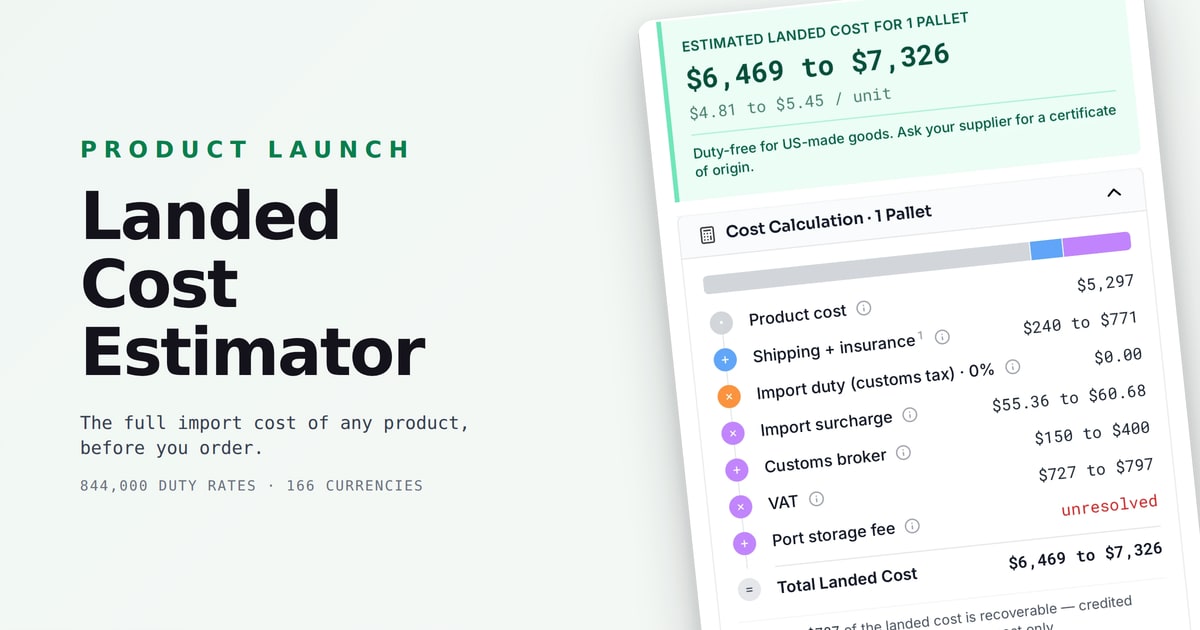
Grovara has launched the Landed Cost Estimator on its global wholesale marketplace. From any product page, an international buyer picks a destination country and a quantity. The tool then shows the full cost of getting that product to their door: the product, shipping, import duty, VAT, excise taxes, deposits, and border fees, each line itemized with the arithmetic shown. It covers 223 countries and territories, and it computes each one the way its own customs authority does.
International buyers rarely know the true cost of an order until the customs invoice lands. Duty tables run to thousands of product lines per country. Taxes stack on other taxes, in an order that changes from country to country. Sugar taxes and alcohol excises turn on facts no catalog holds, such as how strong a drink is and how sweet it is. Packaging deposits turn on what the bottle is made of. So buyers either pay a broker to price each order or pad their margins and hope. Both lose sales. Over-quote, and a workable deal never starts. Under-quote, and the buyer gets a bigger bill than expected and never reorders.
From a product page to a full landed cost
The estimator sits on every marketplace product page. A buyer picks a destination and a quantity, and catalog products prefill their own specs. It returns the delivered cost broken into lines: the product, freight, import duty, VAT or GST, any excise or special tax, deposits, and border and processing fees. Every line shows the number and how it was reached.
It computes what customs computes
The estimator reproduces the arithmetic each authority actually runs. It includes the parts most quotes miss.
It solves Colombia's junk-food tax, which is charged on a base that includes the tax itself. It applies Aruba's rule that any bottle under two liters is taxed as if it were 60% alcohol, whatever the label says. It knows Germany's deposit of about €0.25 per can and marks it refundable. It applies Germany's coffee tax to coffee-flavored biscuits, which most brokers overlook. For Mexico it charges the snack tax only above 275 calories per 100 grams, and it puts the customs processing fee inside the VAT base because Mexican law does. It also shows what a USMCA certificate of origin saves.
When the cost depends on the buyer, it asks
Some taxes turn on a fact only the buyer knows, so the estimator asks one question and prices the answer. A pallet of whisky into Hong Kong is taxed at 100% of value above 30% alcohol, and far less below it. The estimator asks the strength and shows the answer is worth about $25,000. Enter 40% ABV on a UK shipment and it prices the full UK duty table to the penny, then charges VAT on the duty-inclusive value, the way HMRC does. Until the question is answered, the estimate holds a range built from the costlier case, so a buyer is never under-quoted by a guess.
"Global wholesale runs on trust, and the customs invoice is where that trust usually breaks," said Peter Groverman, CEO of Grovara. "For 16 years we watched deals come apart over a cost nobody had priced, like a packaging deposit in Germany or a sugar tier in Qatar. A Mexican processing fee that sits inside the VAT base can lift the whole bill. Now a buyer almost anywhere in the world sees the same number customs will see before they commit a dollar. That's what it takes for a store owner in Belize to buy from a brand in Philadelphia as easily as if they were across the street."
How the rules are built
The tax rules come from primary government sources like national statutes and published customs rate schedules. They are stored as data rather than code, so adding a country or a new tax is a data update rather than a software release. Rates written in pesos or euros convert through exchange rates refreshed daily across 166 currencies. When a rate is missing, the estimator says "not included" instead of guessing. More than 5,400 of its rules are verified negatives: taxes that were checked and confirmed not to apply, so a zero means the tax was examined, not that it was missed.
"Every country invents its own arithmetic," said Gena Diaz, Head of Logistics at Grovara. "Proof-gallons in Costa Rica, degrees Plato on German beer, tax per gram of tobacco per cigarette, syrup taxed on the volume it makes after dilution. I've spent my career translating that for customers one shipment at a time. This does it in two seconds and shows its work line by line. When it doesn't know something, it says so and asks. That's more than I can say for most paper quotes I've seen."
Where it fits for a buyer
For buyers new to sourcing American products, the estimator removes the step that most often stalls a first order: not knowing the delivered cost before committing to it. It sits alongside the documents that clear the goods: the certificate of free sale and the certificate of origin. Our guide to buying from American wholesale suppliers covers the sourcing routes.
Available now on every product page
The Landed Cost Estimator is live on every Grovara marketplace product page. It is free and needs no account. A buyer enters a destination and a quantity, and catalog products prefill their specs. To try it, open any product on the Grovara marketplace and select "Estimate Landed Cost."
Frequently asked questions
What does a landed cost estimate include?
The landed cost is the total cost of getting a product from the supplier to your door in your market. Grovara's estimator breaks it into lines: the product price, freight, import duty, VAT or GST, any excise or special tax, packaging deposits, and border and processing fees. Each line shows the figure and how it was calculated, so you can see where every charge comes from.
Is Grovara's Landed Cost Estimator free?
Yes. The Landed Cost Estimator is on every Grovara marketplace product page, it is free, and it needs no account. You pick a destination country and a quantity, and catalog products prefill their own specifications.
How many countries and taxes does it cover?
The estimator covers 223 countries and territories, drawing on roughly 844,000 import duty rates and 7,700 country-specific tax rules, with rates converted through 166 currencies refreshed daily. The rules are researched from primary government sources such as national statutes and published customs rate schedules.
How accurate is the estimate, and where does the data come from?
Each rule is built from a primary government source and stored as data rather than code, so the estimator reproduces the arithmetic a customs authority runs, including tax-on-tax bases and taxes calculated on a value that already includes duty. When a rate is missing it says "not included" rather than guessing, and more than 5,400 of its rules are verified negatives: taxes that were checked and confirmed not to apply, so a zero means the tax was examined, not overlooked.
Why does the estimate sometimes show a range instead of one number?
Some taxes depend on a fact only the buyer knows, such as a drink's alcohol strength or a food's sugar content. When that happens the estimator asks the question. Until you answer it, the estimate holds a range built from the more expensive case, so you are never under-quoted by a guess. Once you answer, the range collapses to a single figure.
Does it account for trade agreements like USMCA?
Yes. Where a trade agreement applies, the estimator shows what a valid certificate of origin saves. For a qualifying US-origin product shipping into Mexico under USMCA, for example, it prices the duty with and without the certificate so you can see the difference before you order.
What is the difference between the product price and the landed cost?
The product price is what the supplier charges for the goods. The landed cost is what those goods actually cost you once they are delivered and cleared into your market, after freight, import duty, taxes, deposits, and border fees. A quote that looks competitive on price alone can land far higher once those charges are added, which is the gap the estimator closes before you commit.