
How to Buy Wholesale Snacks for Your Store
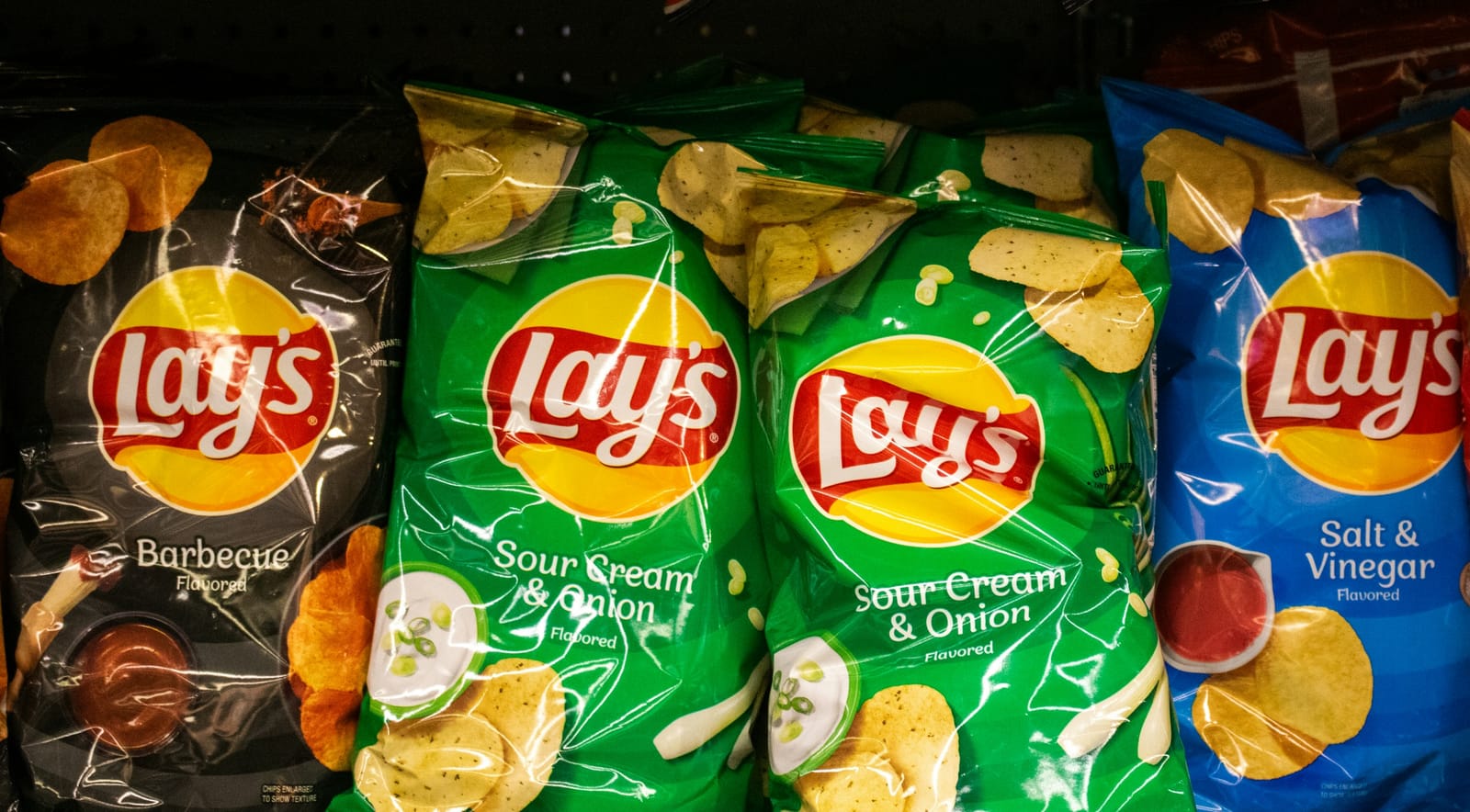
A full pallet of LAY'S Classic Potato Chips in 1-ounce bags holds 72 cases, or 3,240 bags. The chips on that pallet weigh about 203 pounds (92 kg). A pallet of canned drinks can carry close to 1,900 pounds of liquid, as our beverages guide shows. Snacks are light for the space they take, and that fact shapes how a store buys them wholesale.
Snacks also have dates, and some have heat limits. A bag of popped chips can list 274 days of shelf life, and a bag of almonds can list three years. Some chocolate items list chilled storage. Those facts set how much a store should order at once and how it should ship.
Where stores buy wholesale snacks
To buy snacks wholesale, open a reseller account with a snack distributor or a vetted wholesale marketplace. Then order by the case or the pallet. Before you order, read the case pack and the shelf life on each listing. Price the freight by space as well as weight, because chips fill a truck long before they get heavy. Grovara is a global wholesale marketplace where retailers and distributors source snacks from vetted brands.
How snack distribution works
The largest chip makers deliver straight to the store. PepsiCo makes LAY'S and DORITOS. It runs direct-store-delivery (DSD) systems that bring its snacks to retail stores, where its staff stock the shelf (PepsiCo 2024 Form 10-K). Most other snack brands sell to distributors and wholesalers. Those firms sell on to grocers, convenience stores, vending operators and online shops.
A wholesale marketplace sits beside those routes. It lists many brands in one catalog, so a store can order from several brands through one account. That helps a new shop that no distributor will serve yet, or a distributor abroad that wants to test a new snack line.
For planning, split the category by how it travels:
- Light and bulky: potato chips, tortilla chips, puffs and popcorn. These fill space fast and crush under weight.
- Dense and sturdy: nuts, jerky, dried fruit and bars. These ship heavier per pallet and stack well.
- Heat-sensitive: chocolate-coated snacks and some bars. These need cool storage and, in summer, cool freight.
- Meat snacks: beef and other meat jerky. These follow meat rules at the border, which are stricter than the rules for chips.
Case packs and pallet math
Wholesale snacks are sold in fixed packs. Four numbers on a listing tell you what you are buying:
- Units per master case: how many bags or bars ship in one carton.
- Ti × Hi: the pallet pattern. Ti is cases per layer, and Hi is layers per pallet.
- Cases per pallet: Ti multiplied by Hi.
- Units per pallet: units per case multiplied by cases per pallet.
Take the 1-ounce LAY'S Classic bag. Its listing shows 45 bags per master case and a 6 × 12 pallet. That is 72 cases, or 3,240 bags, on one pallet. The listing gives a storage range of 35° to 85° Fahrenheit and ships from Miami, Florida.
Pack sizes change from brand to brand. Rap Snacks OG BBQ Cheddar chips come in 2.5-ounce bags, 10 bags to a case, on a 15 × 9 pallet. That makes 135 cases, or 1,350 bags. Chipoys Chile Limón potato chips use the same 10-bag case and 15 × 9 pattern.
Chips ship air
Freight is priced by weight and by space. Chips are mostly air and packaging, so they run out of space long before they run out of weight. The LAY'S pallet holds 3,240 ounces of chips, about 203 pounds. A pallet of Blue Diamond Smokehouse Almonds holds 128 cases of six 16-ounce bags. That is 768 bags and 768 pounds of almonds on a similar footprint.
In U.S. less-than-truckload (LTL) freight, carriers set a freight class, and density often decides it. Density is the shipment's weight divided by its volume, in pounds per cubic foot. On the 2025 scale, freight under 1 pound per cubic foot is Class 400. Freight at 50 pounds or more is Class 50 (NMFTA). Carrier rates per hundred pounds generally rise with the class number, so light freight pays more for each pound it ships.
The Ka-Pop! Dairy-Free Cheddar Popped Chips listing shows a 48 × 40 × 96-inch pallet with a gross weight of 340 pounds. That works out to about 3.2 pounds per cubic foot, which falls in Class 250 on the NMFTA scale. Ask your forwarder to quote by volume, and plan a container by cubic meters first.
Mixed loads use the space better. Dense goods such as nuts or canned drinks fill the weight, and chips fill the space above them. Put the heavy cases at the bottom of a mixed pallet. Grovara's pallet builder shows how products stack by layer before you order.
Protect bags from crushing
A chip bag is a pillow of air, and a crushed bag sells at a loss. Ask the brand whether its pallets can be double-stacked. Ask for corner boards and full stretch wrap on export loads, and keep heavy cases off the top layer. On arrival, count crushed or torn cases before you sign for the delivery.
Shelf life and date codes
Shelf life ranges widely across snacks. On Grovara, the Ka-Pop! popped chips list 274 days. Western Range Spicy Beef Jerky lists 365 days at 33° to 75° Fahrenheit. The Blue Diamond Smokehouse Almonds list 730 days, and the Blue Diamond Elote Almonds list 1,095 days.
In the U.S., the date on a snack is a quality date in most cases. Federal rules do not require product dating except on infant formula. A "Best if Used By" date marks peak quality (USDA FSIS).
For an export, transit and customs time come out of the shelf life. Ask the brand how many days will remain at shipment, and agree a minimum in writing. Check that each case carries a lot code, so a recall can be traced to the right stock. Grovara's resource on the shelf life statement explains that document.
Chocolate and heat
Chocolate softens in heat, so its storage line matters. The That's It dark chocolate date truffles listing calls for chilled storage at 33° to 37° Fahrenheit. The Mauna Loa Milk Chocolate Coconut Macadamias list ambient storage and a 365-day shelf life. Read the storage line on every chocolate item. Book temperature-controlled freight for any item that lists chilled storage. For ambient items on a hot summer route, ask the brand how it ships them.
What are realistic minimum orders?
Minimum order quantities (MOQs) vary by supplier. Distributors often set a dollar minimum per order. Brands that sell direct usually ask for full cases, and some ask for full pallets. Snack cases are small, so the case minimum rarely hurts. A 10-bag case of Rap Snacks is enough to test a flavor in one store.
Vending operators buy single-serve bags. The 1-ounce LAY'S case of 45 bags fits that use. A buyer abroad faces a second minimum set by freight. A few cartons sent overseas cost a lot per bag, so build a mixed pallet of several brands to spread that cost.
Rules for snack labels and imports
Regulators change these rules often. Confirm the current version with your authority or a customs broker before you order.
Selling snacks in the U.S.
Most U.S. snack makers fall under Food and Drug Administration (FDA) food rules. Ask a supplier which of these apply to its product:
- Allergens: the U.S. recognizes nine major food allergens. Sesame became the ninth on January 1, 2023. A label declares each allergen in the ingredient list, as in "whey (milk)," or in a "Contains" statement (FDA).
- Facility registration: facilities that make or hold food for U.S. consumption register with FDA. They renew between October 1 and December 31 of each even-numbered year (21 CFR 1.230). A foreign facility must name a U.S. agent (21 CFR 1.227).
- Prior notice: FDA must receive prior notice of each imported food shipment. The importer or its customs broker usually files it. The deadline is 2 hours before a truck arrives and 8 hours before a ship arrives (21 CFR 1.279).
- Supplier verification: the U.S. owner or consignee at entry is the importer under the Foreign Supplier Verification Programs (FSVP) rule. That importer must verify that each foreign supplier meets U.S. food safety standards (FDA: FSVP).
Meat jerky follows the U.S. Department of Agriculture (USDA) rules instead. The Food Safety and Inspection Service (FSIS) publishes the countries and plants eligible to ship meat to the U.S. It also publishes each country's rules for U.S. meat exports in its Import & Export Library. Most countries accept the generic export certificate, FSIS Form 9060-5, and some need their own form. The exporting plant must also appear on the destination's eligible list. Saudi Arabia, for example, does not allow pork products (FSIS: Saudi Arabia). FSIS certificates cover meat and poultry. Plant-based jerky such as Unisoy Black Pepper contains no meat, so it falls under FDA food rules in the U.S. Ask your broker which documents the destination wants for it, and check that its label meets local rules.
Destination rules in five import markets
Each market sets its own labels and taxes:
- European Union: the 14 allergens in Annex II must stand out in the ingredient list, for example in bold. When the brand is not based in the EU, the importer is responsible for the label. Labels must use a language that shoppers in each member state easily understand (Regulation (EU) No 1169/2011). Six synthetic colors carry a warning, including tartrazine (E 102) and sunset yellow (E 110). The label must add "may have an adverse effect on activity and attention in children" (Regulation (EC) No 1333/2008, Annex V). Each color must also be permitted for that food category under Annex II of the same regulation.
- United Kingdom: since January 1, 2024, prepacked food sold in Great Britain must show a UK address for the food business. If the brand is not in the UK, the label shows the UK importer's address. The UK uses the same list of 14 allergens (GOV.UK).
- Canada: most prepackaged foods that exceed set levels of saturated fat, sugars or sodium must carry a front-of-package symbol. It is a black-and-white magnifying glass with the words "High in" (Health Canada guide). Companies had until January 1, 2026 to comply, and the Canadian Food Inspection Agency enforces the rule (Health Canada).
- Mexico: under the NOM-051 labeling standard, foods over set nutrient limits carry black warning seals. The seals read "EXCESO CALORÍAS," "EXCESO AZÚCARES," "EXCESO GRASAS SATURADAS," "EXCESO GRASAS TRANS" or "EXCESO SODIO." Mandatory information must be in Spanish (Government of Mexico: NOM-051 manual). Mexico also charges an 8% special tax (IEPS) on listed non-basic foods with 275 kilocalories or more per 100 grams. The list includes snacks (botanas) and chocolate (Ley del IEPS, art. 2, I, J).
- Chile: foods over limits for calories, total sugars, sodium or saturated fat carry black-and-white "ALTO EN" seals. A product with a seal cannot be advertised to children under 14 or sold inside schools (Chile Ministry of Health: labeling manual).
Run each snack through this check for every market you sell in. The Rap Snacks OG BBQ Cheddar listing names cheddar cheese powder and buttermilk, plus FD&C Yellow No. 5 and No. 6. FDA matches Yellow No. 5 to E 102 (tartrazine) and Yellow No. 6 to E 110 (sunset yellow) (FDA color additive summary). An EU label for that bag needs milk set apart in the ingredient list and the color warning line. For Mexico, divide the calories per serving by the serving weight in grams and multiply by 100. A chip label with 160 calories per 28-gram serving works out to about 571 kilocalories per 100 grams, about double the IEPS line.
Many importing countries also ask for proof that a product is sold legally in the U.S. Grovara's guide to the certificate of free sale explains that document.
How to vet a snack supplier
Short-dated stock and diverted stock are the main risks in wholesale snacks. Diverted stock is real product sold outside the channel the brand set up, such as club-store packs bought in bulk and resold. You lose the paper trail, and you cannot tell how the cases were stored.
Ask these questions before a first order:
- Does the seller buy direct from the brand, and can it show an invoice?
- Does each case carry a lot code and a best-by date, with the shelf life the listing promised?
- Is the plant registered with FDA? For meat jerky, is the plant eligible for your market?
- Does the label meet your market's rules, or will someone need to add a compliant sticker?
- Is the price far below every other source for the same item?
One flag may have an innocent cause. Two or more is a reason to stop. Before you list a product, search the FDA recalls list for the brand.
The margin math on landed cost
Your margin is your shelf price minus your full landed cost. For an import, landed cost adds freight, duty, taxes and fees to the wholesale price. Snacks have a low price per cubic meter, so freight can take a large share of the landed cost. Grovara's Landed Cost Estimator is free on every product page, with no account needed. Pick a destination and a quantity, and it estimates freight by mode. With an account, it also breaks down duty and taxes.
A worked example: one pallet of chips to Mexico
On November 11, 2026, we ran one pallet of LAY'S Classic Potato Chips in 1-ounce bags through the estimator, shipped to Mexico. The pallet holds 72 cases of 45 bags, or 3,240 bags. The product costs $1,982, about 61 cents a bag. The estimate came to $2,681 to $4,848 for the pallet.
Landed cost estimate
LAY'S Classic Potato Chips 1 oz, 1 pallet (3,240 bags) to Mexico
Estimated landed cost
$2,681 to $4,848
$0.83 to $1.50 per bag
| Cost line | Amount |
|---|---|
| Product cost | $1,982 |
| Shipping and insurance | $525 to $1,986 |
| Import duty, U.S.-made goods | $0 |
| Customs processing fee | $20.06 to $31.75 |
| Customs broker | $139 to $833 |
| Customs pre-validation fee | $14.50 |
| Importer registry and port fees | Quote separately |
| Total landed cost | $2,681 to $4,848 |
Freight is the line that moves most. At the top of the range, shipping costs more than the chips. Ask for quotes by volume, and fill the pallet before you book it.
Check the label with the calorie method above. If the chips reach 275 kilocalories per 100 grams, the 8% IEPS tax applies on top of the card, so confirm it with your broker. The $0 duty is a claim under the U.S.-Mexico-Canada Agreement (USMCA). Ask your supplier for proof of origin, which Grovara's guide to the certificate of origin explains.
Source wholesale snacks through Grovara
Grovara is a global wholesale marketplace with 10K+ brands and buyers across 60+ countries. Every brand is vetted. On November 11, 2026, the snacks catalog listed 441 products from 46 brands. Chips (82) and nuts (80) are the largest shelves, and no single brand holds more than 15% of the listings.
Other snack pages cover cookies, protein bars, dried fruit, puffed snacks, fruit bars, jerky, snack bars, fruit snacks, popcorn and pretzels. Sweets have their own candy and chocolate pages. Our wholesale candy guide covers buying them.
Brands in the snacks catalog include:
- Frito Lay: 37 snack listings, including LAY'S, DORITOS, FRITOS and SUNCHIPS in single-serve and larger bags.
- Rap Snacks and Chipoys: bold-flavored potato chips in 2.5-ounce bags, 10 bags per case.
- Blue Diamond Growers: 15 almond listings, most with shelf lives of two to three years.
- Western Range and Unisoy: beef jerky, including a halal-certified line, and plant-based jerky.
- Ka-Pop! Snacks: sorghum-based popped chips and puffs.
- That's It: 37 listings, from fruit bars to chilled chocolate truffles.
- Costco listings: club packs such as Kirkland Signature Unsalted Mixed Nuts. Grovara resells these listings as an independent company. It is not affiliated with or endorsed by Costco.
Buying takes five steps:
- Join as a buyer. Grovara membership explains the buyer terms.
- Find the product. Search in plain language with Scout AI, for example "spicy potato chips in single-serve bags for vending."
- Ask the brand. Chat with the brand owner inside the platform. Ask how much shelf life will remain at shipment, and whether the pallet can be stacked.
- Check the landed cost. Run the Landed Cost Estimator for your country and quantity.
- Build the pallet and order. Mix products on one pallet with the pallet builder. Grovara auto-generates the compliance documents for the order.
Label changes for your market are a separate step. Agree them with the brand before you order, especially for markets with front-of-pack warnings.
Is wholesale snack sourcing right for your store?
Snacks fit a convenience store, a grocer, a vending route, a gym, an office pantry or an online shop. They also fit a distributor abroad that wants to add snack brands without a buying trip. For a simple first order, start with chips and nuts in small cases. Add chocolate and meat jerky once you have cool storage and know your market's rules.
Browse the snacks catalog and place a first order small enough to test demand. Stores that also stock drinks can read our guide to wholesale beverages and fill the same pallet with both.
Photo by Zoshua Colah on Unsplash.
Frequently asked questions
How do I buy wholesale snacks for my store?
Register your business, then open a reseller account with a snack distributor or a vetted wholesale marketplace. Order by the case or the pallet. On each listing, check the case pack and the shelf life. Price the freight by space as well as weight. A marketplace such as Grovara lets you order from many snack brands through one account.
Where can I buy snacks in bulk to resell?
Buy from the brand or from a source the brand supplies, such as an authorized distributor or a vetted wholesale marketplace. Club-store packs bought in bulk and resold carry risk, because you lose the paper trail and cannot tell how the stock was stored. Ask any seller for an invoice that shows where it bought.
How many bags of chips are in a wholesale case?
It depends on the bag size. On Grovara, a case of 1-ounce LAY'S Classic holds 45 bags, and a case of 2.5-ounce Rap Snacks holds 10 bags. Ka-Pop! popped chips ship 12 bags per case. Always check the units per master case on the listing.
How much does a pallet of chips weigh?
Very little for its size. A pallet of 1-ounce LAY'S bags holds 3,240 ounces of chips, about 203 pounds. A Ka-Pop! pallet stands 96 inches tall and weighs 340 pounds gross. Freight for chips is usually set by space, so ask for a quote by volume.
How long do wholesale snacks last?
It ranges widely. On Grovara, Ka-Pop! popped chips list 274 days, while Blue Diamond almonds list 730 to 1,095 days. In the U.S., a "Best if Used By" date marks peak quality. For an export, agree in writing how many days will remain at shipment.
Can I ship chocolate snacks in summer?
Yes, if the freight matches the listing. Some chocolate items list chilled storage. The That's It chocolate truffles, for example, list 33° to 37° Fahrenheit, so book temperature-controlled freight for them. Read the storage line on every chocolate listing, and keep summer orders small if you have no cool storage.
What labels do snacks need for Mexico?
Mexico's NOM-051 standard requires black warning seals, such as "EXCESO SODIO," on foods over set nutrient limits. Mandatory label text must be in Spanish. Mexico also charges an 8% IEPS tax on listed non-basic foods, including snacks and chocolate, with 275 kilocalories or more per 100 grams.
Can I see the landed cost before I buy snacks on Grovara?
Yes. The Landed Cost Estimator is free on every Grovara product page, and you do not need an account. Pick your country and a quantity. It estimates freight by mode. With an account, it also breaks down duty and taxes.
Sources
- PepsiCo: 2024 Form 10-K (direct-store-delivery) (opens in new tab)
- NMFTA: Decoding density, the freight factor you cannot afford to overlook (opens in new tab)
- USDA FSIS: Food product dating (opens in new tab)
- FDA: Food allergies (opens in new tab)
- 21 CFR 1.230: Food facility registration renewal (opens in new tab)
- 21 CFR 1.227: Definitions, including U.S. agent (opens in new tab)
- 21 CFR 1.279: When prior notice must be submitted (opens in new tab)
- FDA: FSMA final rule on Foreign Supplier Verification Programs (opens in new tab)
- USDA FSIS: Import & Export Library (opens in new tab)
- USDA FSIS: Export requirements for Saudi Arabia (opens in new tab)
- EUR-Lex: Regulation (EU) No 1169/2011 on food information to consumers (opens in new tab)
- EUR-Lex: Regulation (EC) No 1333/2008 on food additives (opens in new tab)
- FDA: Summary of color additives for use in the United States (opens in new tab)
- GOV.UK: Food labelling, giving food information to consumers (opens in new tab)
- Health Canada: Front-of-package nutrition labelling, regulations and compliance (opens in new tab)
- Health Canada: Front-of-package nutrition symbol labelling guide for industry (opens in new tab)
- Government of Mexico: Manual for the modification to NOM-051-SCFI/SSA1-2010 (opens in new tab)
- Cámara de Diputados: Ley del Impuesto Especial sobre Producción y Servicios (opens in new tab)
- Chile Ministry of Health: Food law and nutrition labeling manual (opens in new tab)
- FDA: Recalls, market withdrawals and safety alerts (opens in new tab)